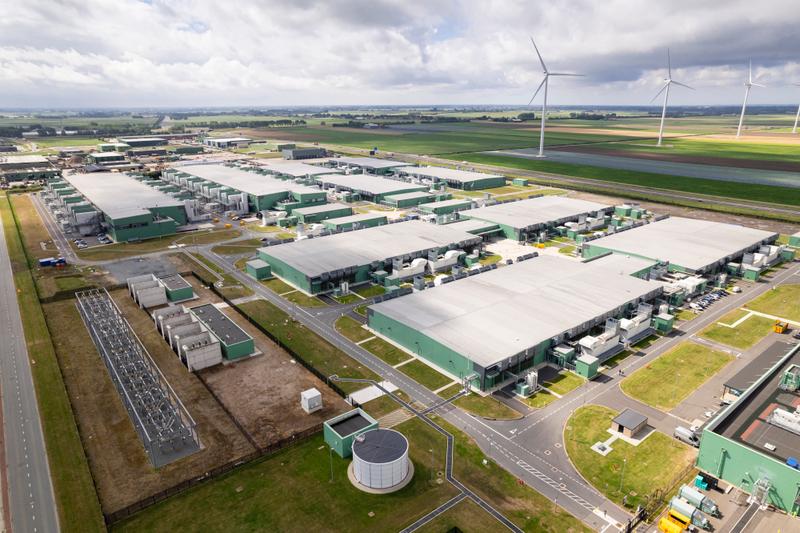
Hyperscalers driving the artificial intelligence (AI) revolution have been spending hundreds of billions annually since 2024 to build AI infrastructure. This includes data centers equipped with various chips, memory, servers, and more to power the insatiable demand for AI, whether from consumers using large language models (LLMs) or companies building out AI solutions or integrating AI into their existing businesses. Next year, that number is expected to rise to $1.3 trillion from just six of the major hyperscalers, according to a new report from S&P Global. Only one of these companies—Microsoft—is projected to have positive free cash flow (FCF) next year.
The six companies included in S&P’s report are Alphabet (GOOG, GOOGL), Amazon (AMZN), Meta Platforms (META), Oracle (ORCL), and SpaceX. Collectively, these companies had $470 billion in capital expenditures (capex) in 2025, with forecasts of $870 billion this year and a projected $1.3 trillion next year. This represents a 50% increase in AI capex for 2027 compared to 2026. Most CEOs of these companies expect strong capex growth in 2027, despite recent spending having begun to strain their balance sheets, particularly for Alphabet, Amazon, Meta, and Microsoft, which have historically generated phenomenal free cash flow (FCF) and earnings.
All CEOs have defended this spending, arguing it will yield strong returns and failing to invest would be riskier, given AI’s transformative potential. However, institutional investors remain skeptical, despite strong AI-related revenue growth. In Q2 2024, three of these companies still generated free operating cash flow. If S&P Global’s projections are accurate, only Microsoft will have positive FCF in 2027.
Here are the projected 2027 capex and FCF figures: - Alphabet: $357B (FCF: $82.7B) - Amazon: $319.1B (FCF: $60.1B) - Meta Platforms: $164B (FCF: $3.5B) - Microsoft: $189B (FCF: $33.6B) - Oracle: $95B (FCF: $41.6B) - SpaceX: $197.2B (FCF: $114.4B)
S&P Global notes that Microsoft’s reliance on leases could allow it to reclassify certain capex as operating leases, improving FCF. Microsoft also has over $329 billion in future lease obligations, the highest among these companies. The report suggests that while Microsoft retains the highest credit rating (AAA), others may follow its accounting practices, impacting perceptions of capex sustainability.
The long-term outlook remains uncertain: S&P Global predicts an inflection point in 2028, with capex flattening and revenue accelerating, potentially leading to a return to positive FCF. Investors are questioning whether this will materialize and if the massive investments will yield strong returns.
Source: The Motley Fool